The Blank Page

  • To Prompt or Not To Prompt (and some handy prompts!)

    At Write Club we find that most of the time our teen writers want to come up with their own ideas and that they’re much more passionate about those ideas (and take them much further) than any that come from writing prompts and exercises. I find it much more beneficial to give a writer 5 minutes of quiet time to think of an idea than to give them a bunch of prompts.

    However.

    Prompts have their uses. Some writers love prompts. And sometimes you’re just feeling a bit stuck with a project and you want something new and low-stakes to tinker with. Sometimes you’re too tired from a whole day at school to think of an idea. Sometimes you want a springboard to launch an idea you already have. I’ve written whole novels in response to prompts. So we always have a few prompts at the ready for anyone who wants one.

    Where do we find these prompts? Well, one brilliant source that I like to use, is the last line of chapter 1 of the nearest novel to hand. 95% of the time, it’s a cracker.

    Why is that? It’s because the end of chapter 1 is very often a springboard into the story. We all know that the ‘inciting incident’ – the event that sets the story in motion – has to happen close to the start of the book. In children’s/YA books especially, this can very often be in chapter 1, because kids do not have time to hang around and wait for it.

    The last line will often be something like a cliffhanger or a hook or something intriguing or mysterious, something that makes you want to read on. They make excellent prompts.

    I usually provide 2 or 3 of them to choose from, and the writer can use them however they like. They can turn it into a story, poem, play, song lyrics… They can quote it directly, reword it, or just use it as inspiration for a place or character.

    They also have the added benefit of maybe encouraging your writers to go and read that book, so I always make sure they know which book the line came from.

    Try it, grab a few books and check out the last line of chapter 1. I guarantee you’ll find several that will make good prompts. And in the meantime, here are some good ones I’ve found recently.


    A whoop-whoop sound startles us, and blue lights flash in the rearview mirror. (The Hate You Give by Angie Thomas)

    I had the strangest feeling something or someone was waiting for me, right here at Knockmore. (Knock Back by Pauline Burgess)

    I got all the answers wrong. (Not my Problem by Ciara Smyth)

    I know this is going to sound strange, but would you mind being my girlfriend for the next five minutes? (Nick and Norah’s Infinite Playlist by Rachel Cohn and David Levithan)

    You see, the what ifs are as boundless as the stars. (Maggot Moon by Sally Gardner)

    His name was P.T. Barnum, and he’d been looking for a mermaid. (The Mermaid by Christina Henry)

    It’s quite rare to find someone who sees the same world you see. (Turtles all the way down by John Green)

    Four hands were immediately laid upon me, and I was borne upstairs. (Jane Eyre by Charlotte Bronte)

    Covered in blood, with his neck bent at a horribly wrong angle and his eyes wide open, staring at nothing. (Two Can Keep a Secret by Karen M McManus)

    FREDDIE IS BACK FROM FRANCE AND I THINK TONIGHT IS THE NIGHT! (Lobsters by Tom Ellen and Lucy Ivison)

    And then the first drops of rain began to fall. (The View on the Way Down by Rebecca Wait)

    I’m still spitting up bits of sausage when I hear the loud rap at the door. (Taking Flight by Sheena Wilkinson)

    But the noise is everywhere. (Are We All Lemmings and Snowflakes? by Holly Bourne)

    All he’s heard are the rumours, stories, the speculation, and the swiftly lost words of whispered secrets, about the island where people have started to live forever. (Midwinterblood by Marcus Sedgwick)

    Her second birth was the day the Watcher took her as its host. (Eliza and Her Monsters by Francesca Zappia)

    One more’ll make no difference. (The Watch House by Bernie McGill)


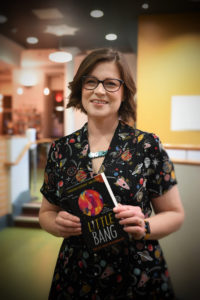
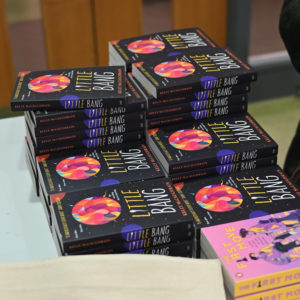
    In other news, my new YA novel, Little Bang, was published this month by Walker Books and we had a fabulous launch party at The Crescent Arts Centre. You can find out more about the novel here!
     

  • Write here, Write now!

    A new term, a new opportunity to write! There IS a budding novelist in your school. There’s also a poet, a playwright, a journalist, a diarist. There is someone using writing to process their feelings and understand the world. There is someone hiding their writing because they’re shy and they don’t know anyone else who writes. Do they have a writing club to go to?

    If not, why not help them start one up? It’s easier than you’d think and there’s lots of advice here.

    And a beautiful article here about teaching creative writing:

    “When the writers start sharing their work out loud, those stereotypes shatter. Then students become people with their own stories, who so badly want to be heard and understood. I’m always surprised at people’s complexity. And willingness to be vulnerable, in hopes of being heard. I’m grateful for the opportunity to cross the threshold of the classroom — a field of possibility — to encounter it.”

    (To be clear, the article is about writing workshops, where actual teaching happens. I REALLY don’t think you need to be a writer to lead a writing group, and I don’t think you need to teach young writers in your group, you just have to be there to create that space in which they can write, listen to their words and tell them what you loved about them. But the article is really insightful about how much that can mean for a young person and has lots of tips and tricks for working with them.)

    “Teaching writing requires showing unabashed love, giving ready praise, sharing your appreciation of precision and specificity. Be unafraid to tell young people what you think is wonderful about their ideas and work, and what could be stronger. Just be gentle and do it with respect for whatever limits they’re working within.”

    And if you already have a group, check these out:

    BBC radio’s Two Minute Tales writing competition is back. The theme is What Happened This Winter and there are three age categories from 5-16, and this year there’s also an Irish Language category for ages 5-11! Send in your 300 word short stories by 7th November and they could be read on the radio in the week before Christmas, and maybe even turned into an animation for the website!

    Following on from the success of their first Zine on the theme of Belfast, Fighting Words NI are publishing a new one. This time the theme is Happiness and entries should be in by 20th November. It’s open to anyone aged 8-18 and you can submit any form of writing.

    They also have a page of free resources including video workshops and podcasts on writing.

    And their teen writing group Write Club is open to all teen writers, with meetings happening in person in East Belfast, or on zoom.

    Speaking of which, we’ve had lots of publications from Write Club members recently, including this one by 15 year old Kaila in the Afterpast Review, a feminist literary magazine dedicated to uplifting underrepresented voices (and open to submissions so check it out). Kaila’s story is beautiful, have a read with your coffee break! 


  • It’s September!

    January is all very well but September has always felt like a much more exciting New Year to me. Probably because of the stationery. So what better reason to buy some super sharp new pencils and… start a Creative Writing Club?

    If your school doesn’t have one already, there are SO many good reasons for starting one.

    1. It’s hugely beneficial educationally and psychologically to be creative. You’ll be giving your students such an important gift.
    2. It’s also an amazingly relaxing, heart-warming, and bonding experience just to sit in a room with a bunch of people quietly putting their thoughts on paper. And when they share those thoughts with you it’s honestly such a privilege and a joy.
    3. It’s SO much fun! Teenagers have incredible imaginations and ideas. My group inspire me constantly by coming up with stuff I could never have thought of. My mind is regularly blown.
    4. You get tea and cake!
    5. You get to hang out in the library after school like the cool kids in The Breakfast Club.
    6. It doesn’t cost a thing!
    7. It’s super easy!

    Seriously, it is. If you’d like to set up a group but you’re worried that it’ll be a lot of work, or that you have to be a writer yourself, don’t. It’s so easy. In fact, the less you do, the better your group will be. I think the worst thing you can do is march in with a lesson plan and a PowerPoint presentation. It’s tempting to do that because we worry that if we don’t control things, nothing will happen, or if there’s a silence we need to fill it. But creativity happens in the gaps. In the unstructured, daydreaming, free time that teenagers get less and less of as they go through school.

    All you need to provide for your group is time and space (and cake, obvs). If you’re new to this, have a look through the early posts on this blog, where I outline what I do with my group. It mostly involves letting my young writers bring their own ideas and letting them get on with it, but there are also some resources for writers who like writing prompts, or writers who want advice with things like character building, idea generation, dialogue writing etc.

    But honestly, I’ve always got the best results by letting my young writers just pursue their own ideas. They’re always much more enthusiastic about those ideas than they are about any prompt or exercise I could give them. And if you give them five minutes to think, they always come up with something they want to write. It’s such a gorgeous thing to witness the light suddenly come on in someone’s eyes and see the real world disappear for them as they dive into a new one.

    I beg to differ, Boromir.

    And all you need to know about writing is how to listen and tell them what you loved about their work. There’s advice on that here too, but really it’s very simple. If you’re a reader, you’ll be fab at it. And your feedback and encouragement could mean so much to them.

    I was a young writer once and I would have loved to have had writer friends and someone to encourage me but my school didn’t have a writing group so it was quite a lonely experience. I created this website because I know what these groups could mean to kids like me. So this is my annual plea to teachers and librarians to start your own club! Please Please Please!

    And do feel free to email me if you have any questions or worries about starting a group or just want to chat about it!

    And if you’ve already got a group going, yay, and here are some opportunities you could tell your young writers about:

    • Fighting Words NI have expanded their Write Club sessions so that, as well as the zoom groups in Prose&Poetry, Journalism and Playwrighting, there’s now an in-person group starting tonight 4.30-6pm at the Skainos Centre on Newtownards Road! Write Club is always free and all teens are welcome.
    • Fighting Words are also running a free story-writing workshop for 12-18s at the Skainos Centre on Thursday 22nd September 6-8pm. Participants will invent characters and create an original story set in Belfast and brought to life by an on-site illustrator! Book your place here.
    • The Paper Lanterns Journal of writing for and by young adults is always open for submissions (and if you have a club, why not subscribe to the journal! It’s always so inspiring for young writers to see published work by people their age, and they’re based in Ireland!)

    Hope you all had a fantastic summer. I was off camping for two months and I actually really missed my writing group! It’s been great to get back to them and read what they’ve been writing. (One of them finished a whole novel! My inner teenager is in a state of deep awe.)

    I shall be back with more opportunities and 1990s based memes and in the meantime, all my best to you and your young writers for the year ahead.


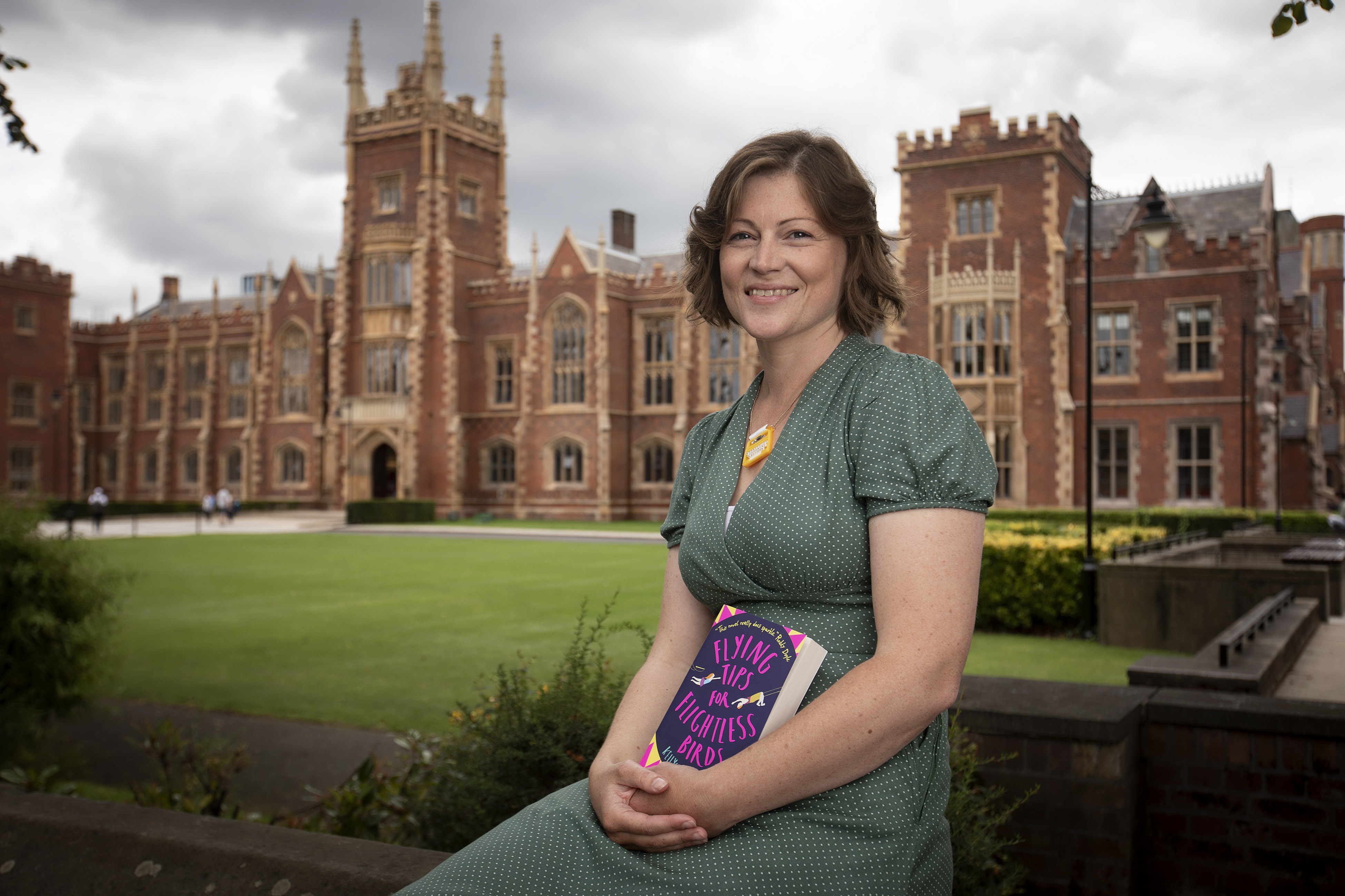
The Blank Page was created by Kelly McCaughrain, Children’s Writing Fellow for NI (2019-2021), as a support and resource for Librarians and Teachers running Creative Writing Groups in post-primary schools.

To read all the posts from the beginning, click here.

Recent Posts