The Blank Page

  • Grown Up Writing

    As it’s WORLD BOOK DAY (!!!) I’ve been writing articles for a couple of newspapers about encouraging kids to read, which basically means me banging on about getting parents to read. (If you treat reading like it’s ‘Kids Stuff’ or ‘Homework’ or ‘A Less Valuable Use of Your Time Than Facebook’, then your kids will see it that way too.)

    It occured to me that we could say the same about writing and creativity in general. I was also inspired by this blog post by the wonderful NI children’s writer, Sheena Wilkinson.

    Sheena, as well as writing many wonderful books (new one launched today!!!), used to be an English teacher and has taught creative writing workshops for years. I recommend the blog post (and her books), but to summarize, she says that in a survey of secondary school teachers she once did, she found that:

    “The vast majority admitted to feeling underconfident when it came to teaching creative writing. Most had not themselves written creatively since GCSE days, having studied English Literature only for A level and at university. Every year I give a short creative writing workshop to PGCE English students: two hours out of a year-long course. (It used to be three.) The students seem to enjoy the chance to write, but it’s a hard sell to make them see it as important. They think it’s a bit of a jolly, not to be confused with real work. And they are always more concerned about how they can use the skills and insights in the classroom than recognising their intrinsic value for them.” 

    In our writing group I’ve always felt it was important that the volunteers be seen to be writing or reading along with the kids. Not chatting, answering emails, scrolling on phones or catching up with work. I want them to see that writing and reading are not just things you’re made to do in school and then can leave behind when you’re an adult like calculus and Latin vocab. I want them to see adults writing, adults having a bad writing day, adults coming back next week and trying again.
    You don’t have to be a writer to lead a writing group. You don’t have to be a ‘Writer’ to do some writing either. Why not give it a go yourself? At the very least, you’ll have more of an understanding of what your young writers are going through when they pick up a pen, when they overcome their inner critic long enough to put words on the page, when they are brave enough to read their work aloud, when they make time in their busy lives to come to a writing club. You might even find it’s as beneficial for you as it is for them!
    Neil Gaiman says so

    Sheena also notes that, although there are wonderful initiatives out there to encourage creativity in schools:

    “Increasingly these initiatives are in primary schools, not secondaries ‘because we don’t have time for that’, and usually when I am delivering the workshop the class teacher is marking, or on the computer. Understandable given their workload, but it reinforces the idea that creative writing isn’t really important, or something you would do as part of normal life, or continue to do as an adult.”
    If writing really isn’t for you, then that’s fine. But maybe read something instead. Read some YA. Ask them to recommend some YA. Be part of their group, not just the leader of it, and show them that reading and creativity is as valuable in adulthood as it is in childhood.

    I suspect the root of all of these problems is that, for all our ranting about the importance of reading and creativity for kids, maybe adults don’t really believe they’re important at all. We certainly seem to think they’re less important the older you get. Not important enough to continue into secondary school. Not worth making time for in adulthood.

    Recently I was talking to someone about how adults will blithely walk into the room where our young writers are writing and not even lower their voices. We’re in a slightly public space, which we love and are grateful for but it’s a community centre and people will walk through while having conversations, answer their phones, have meetings, even play music. I’d always just accepted this as part of the nature of the space but my friend pointed out that if we were a group of adults sitting around a table working, people would have a much more respectful attitude towards the work going on, and that this is just typical of the way we treat young people and anything they’re involved in.

    I think she may be right, and if we treat reading and creativity as ‘kids stuff’, then kids will pick up on that and see it that way too. They want to be adults. They want to be like us. And if that means treating books and writing like they’re childish, or luxuries we don’t have time for, or less important than our phones, rather than valuable parts of our lives and continuing development, then of course they’re going to quit the moment they leave school.
    I’m as guilty of this as anyone. Adult life is busy and I don’t read or write half as much as I should and I know if I put in a bit more effort I could make more time for it. But I do make sure that my young writers see me and the other volunteers reading and writing.

    I visited Sullivan Upper this week where they told me that when they have someone in to give a writing workshop they invite the staff too. So adults come and participate and write along with the kids. I thought that was the best idea ever!

    So be the change! Be the adult you’d love to see them grow into. Ask yourself if you really do value creativity, and if you do, then give yourself the gift of making time for it in your own life. And maybe you could make your writing group open to staff members who’d like to do the same!



  • Elevator Pitch

    This exercise is based on the notion of the ‘Elevator Pitch’ and it’s just a way to get the imagination going.

    The Elevator Pitch is based on the idea that if you ever happened to get in a lift with a top publisher/director/agent, you could tell them the idea for your brilliant book/film/play in the time it takes to get to their floor.

    The lift scenario is quite unlikely (agents probably take the stairs for exactly this reason) but every writer is supposed to have their elevator pitch ready to go at all times.

    It’s a sentence or two that encapsulates what is great about your story, makes you want to hear more, and it has to be really short (50 words MAX) so cut out anything irrelevant.

    Sometimes elevator pitches are much better than the actual books. So it can be fun to skip the book-writing part and go straight to the pitch!

    For this exercise:

    • Explain to your writers what an elevator pitch is (show them the examples below and maybe talk about why they’d make you want to read on, what they include and what they leave out)
    • Ask them to write ten elevator pitches of their own for stories that would make people want to know more, even if they have no intention of ever writing them.
    • Share them with the group. (You could have a prize for the one that makes everyone go, ‘Ooooh! I’d read that!’)

    • Tell people that if they’ve been inspired by a pitch (their own OR someone else’s) they can have a go at writing it.


    Examples taken from How to Write an Elevator Pitch on Jericho Writers :

    Twilight
    A teen romance between an ordinary girl and a boy who is actually a vampire.
    [15 words]

    The Da Vinci Code
    A professor of symbology unlocks codes buried in ancient works of art as he hunts for the Holy Grail.
    [19 words]

    Gone Girl
    A wife (Amy) goes missing, and her husband is suspected of murder. But the sweet diary-writing Amy of the first half of the book is revealed to be a very different woman in the second half . . .
    [36 words]

    The Martian
    Astronaut, stranded on Mars, has to figure out how to survive.
    [11 words]

    Brokeback Mountain
    A love story between two male cowboys
    [7 words]

    Harry Potter series
    Orphan boy goes to school for wizards
    [7 words]

    Alex Rider series
    Young James Bond
    [3 words]

    Or you can do this


  • Unscripted

    I think it’s a little odd that script-writing doesn’t come up much in the curriculum. I suppose technically Shakespeare plays are scripts but it never felt like they were being studied as scripts, and they certainly weren’t related to creative writing in my experience.

    But when you think about it, scripts are maybe the form of writing most familiar to kids. They probably have a lot more exposure to TV and Movies than novels or poetry.

    Anyway, if you’d like to introduce script writing to your group, or you have a writer who’s interested in scripts, may I direct you (and them) to the BBC Writers Room site. It’s a huge site full of resources for script writers. They actually run this site to attract the scriptwriters of tomorrow and they regularly run courses and competitions and submissions slots for scriptwriters.

    But you don’t have to be a professional to get a lot out of the site. There is a fantastic script library, that has the full scripts of various TV shows and films for you to read. This is quite helpful for learning how to lay out a script as well as write one, but they also have separate articles on how to format the different kinds of scripts. There are interviews with directors and writers, videos with exercises for script writing, and genre toolkits so you can learn about the different kinds of scripts. It’s just somewhere you can point your writers to if they’re interested.

    If you’d like to talk to them about scripts that they might not have considered before, you could suggest they try a radio script.

    As a prose writer myself, I sometimes forget that poetry exists, never mind scripts. And Radio isn’t usually the first thing we think of, even when we do remember that scripts are also writing. And we usually associate radio plays with middle aged, middle class Radio 4 listeners, not teenagers, but they can actually be a lot more fun to write than stage/TV/film scripts.

    We tend to think of Radio as being limited because of its lack of visuals, but in fact, when you’re writing a script, this is its strength. It’s completely unlimited. You can create anything on radio, just with sound effects. Which means that you, unlike George Lucas, can do a 3-generation, 9-episode space epic with zero budget. No CGI, no costumes, no massive crew, no lighting, no cameras, no sets, no stage makeup, you can even have the actors play multiple roles.

    Low budget movie. Still more expensive than you can afford.

    Radio is a completely limitless medium. If you can imagine it, you can write it. And if you have an aspiring scriptwriter who wants to go as far as actually making the end product, many of the sound effects have already been created and are available to download online and the rest you can create yourself.

    But if your writers just want to write a script and aren’t bothered about it being made, then of course they can do TV space battles to their heart’s content.

    I also found this on the Writers Room site and thought it was useful for any kind of writing, script or otherwise, so you could print it out and give it to your writers as a little checklist for when they’re brainstorming or stuck –

    John Yorke’s 10 Questions are used by top TV writers all over the UK to unlock and refine their stories: 

    1. Whose story is it? 
    2. What does the character need?
    3. What is the inciting incident?
    4. What does the character want?
    5. What obstacles are in the character’s way?
    6. What’s at stake?
    7. Why should we care?
    8. What do they learn? 
    9. How and why? 
    10. How does it end? 

    (NB: the inciting incident is just the thing that draws the character into the story. Eg Her name is drawn at the Reaping, He gets a letter from Hogwarts, She is orphaned, A stranger arrives in town etc)

    Here we go…

    In other news, I’m planning some exciting guest posts from some real live published authors (!) to talk about their writing journey, share their top tips for great writing, and inspire your young writers! Watch this space…


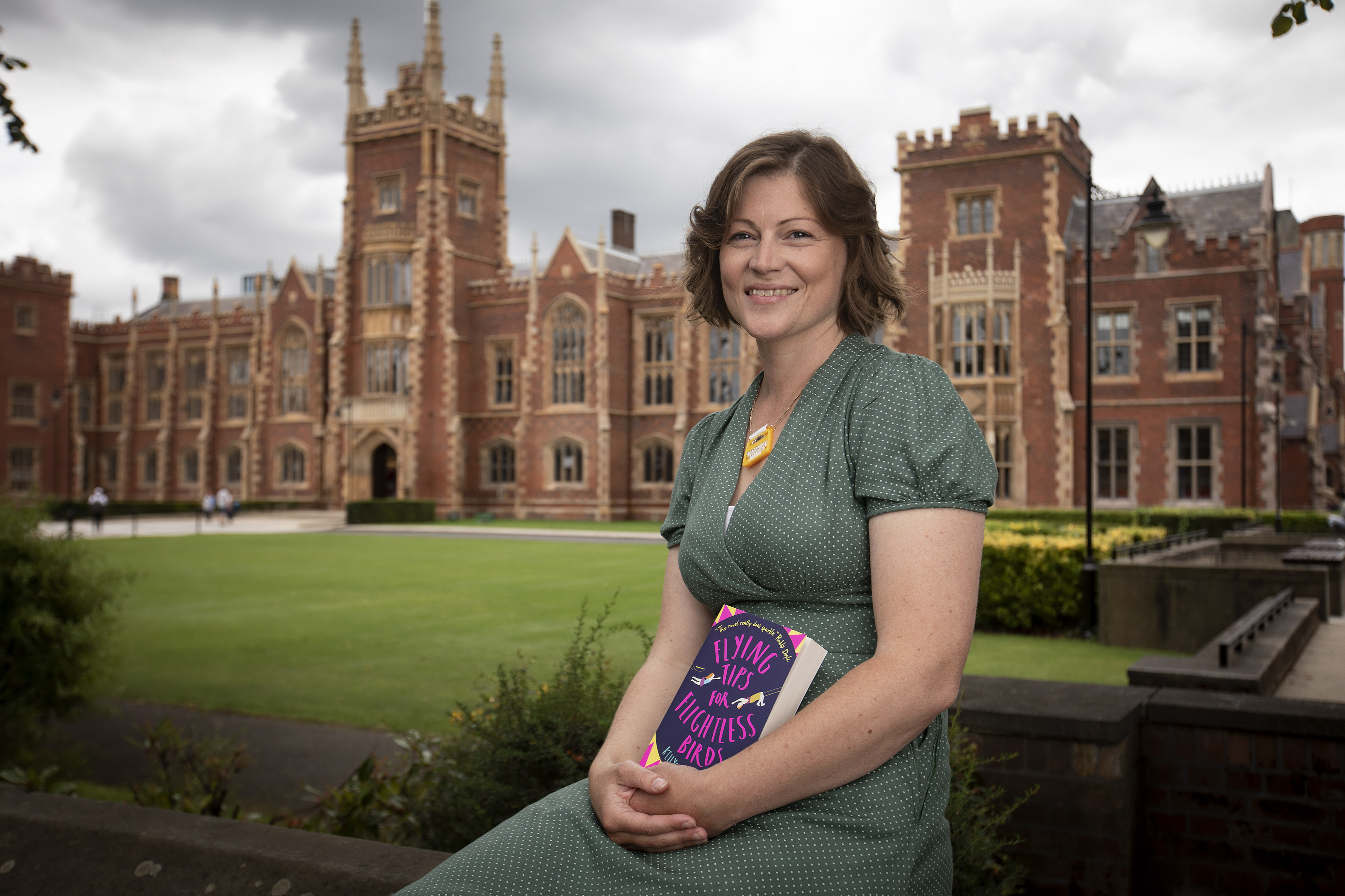
The Blank Page was created by Kelly McCaughrain, Children’s Writing Fellow for NI (2019-2021), as a support and resource for Librarians and Teachers running Creative Writing Groups in post-primary schools.

To read all the posts from the beginning, click here.

Recent Posts