The Blank Page

  • Easy Peasy Poetry

    Hope you had a great half term!

    This is a quick poetry writing exercise I found on Ted Talks. It’s an 18 minute video in which he explains the three steps for writing a 2-line poem. The audience write along with him and produce their 2-line poem (I did it myself, it was fun) so I played it for my writers and invited them to write along.

    About half of them decided to give it a go, others were working on their own stuff. Of the half that started, a few dropped out along the way, one turned hers into a piece of prose instead, and just one completed a poem. She then turned it into a longer poem.

    I just wanted to point out that this is fairly typical and I don’t mind at all if I introduce exercises and they either fall flat or only one or two people get anything out of them. Inspiration is such a personal thing that I’m quite impressed if something does speak to more than a couple of them, and even if it only works for one of them, I consider that completely worth it.
    I also think it proves, again and again, what I’ve always felt – that they get much more out of coming up with their own ideas. Everyone at our meeting last week wrote something, I didn’t care whether it was a 2-line poem or not. And if it’s something they’ve come up with themselves then it’s usually going to be much more personal and important to them than something they’ve come up with in response to an exercise.

    I’m very aware that I’m posting all these little exercises for you to use (and I have used them and found them all helpful in various ways myself), but I want to stress that most weeks I don’t ask them to do anything in particular at all, I just let them write whatever they want. And although we have our prompt box and flash fiction prompts, they rarely need them. I think it’s actually more beneficial for them to come up with their own ideas. That’s what creativity is, after all. It’s great to have some backup prompts and exercises to support them if they need them or want them, but in my experience they generally don’t.

    So please don’t feel that you’re not doing enough if you’re not bringing in inspirational exercises every week or your group aren’t all writing heartfelt responses to your poetry exercise! You’re doing everything you need to just by giving them your time and space and attention.

    *NB: in the video he writes a poem for a friend who took his own life, and he asks the audience to write theirs about someone they’ve ‘lost’. I made a point of saying to my writers in advance that this could be someone they haven’t seen in a while, someone they used to know, an old teacher or neighbour or pet, or just someone they do still know, it didn’t have to be someone who had died and that if they felt that writing about this would be upsetting then they shouldn’t do it and they could interpret the exercise any way they wanted.

    Happy Poeting!



  • 8 Ways To Make Your Story Boring

    As I keep saying, you really don’t have to be a writer or teacher yourself to run a writing club for young writers. All you need to be is a facilitator. An enthusiastic cheerleader willing to listen and applaud.

    The time and space and attention you provide are the important things and that’s all your young writers really need, so never be put off by worrying that you don’t know enough about writing or teaching writing. You don’t need to.

    As I am a keen reader and a writer myself, I often do try to offer feedback that might help a writer improve their craft if I feel that’s what they want (some don’t, others actively ask, ‘How can I improve this?’), but actually I find the feedback I give tends to be the same few rules repeated over and over again, in response to the same rookie mistakes all new writers make.

    It’s NEVER just once

    It’s really quite simple stuff and this article I found online covers pretty much all of it, so if you do want to help your writers improve their craft, you can kill all the badly written birds with one stone and just print it for your group to read! –

    Link: 8 Ways To Make Your Story Boring

    If anyone is keen to improve their writing just tell them to go back and look at these 8 rules again and see if they’ve broken any of them, then do some editing to improve their piece of writing.

    The only other thing I regularly say that isn’t in this article is ‘Character is everything.’ If you’re stuck, it’s because you don’t know your character well enough. So go back and interview them, interrogate them, brainstorm what they’d do in a situation, and they will lead you to the ending!

    I won’t post next week since it’s half term and you’ll all have much better things to do (marking, yeah?) but I’ll be back the week after!

      Enjoy!


  • Writers in Residence

    It’s been so great to hear from librarians and teachers who are planning to set up creative writing groups in their schools, and some of them have asked for advice about whether to make it an afterschool group or a lunchtime one.

    I know some of you already have groups running so I’d be interested to hear your thoughts on this.

    I’m sure there are pros and cons to both. My feeling is that afterschool is maybe better because it feels like time focused on writing, whereas lunchtime is really the only break the kids get in a long school day and the only chance to chat to their friends, so it might be harder to get them to settle, and also they wouldn’t have very long.

    Our group runs after school (4-6pm) so we have 2 hours, which I realise is a luxury but even an hour would work fine. I read an article recently about how shorter lunchtimes are contributing to the demise of creativity in schools because you can’t really fit a meal and a creative activity into 35 minutes. I remember in my school it generally took a good 25 of our 35 minutes to get to the top of the canteen queue.

    An afterschool group can be longer and the library may be quieter and the librarian less busy or distracted than at lunchtime. But an afterschool group also has the problem of kids needing to get picked up by parents or having other afterschool activities to go to. At least at lunchtime they’ve nowhere else to be.

    So, pros and cons.

    I think a lunchtime group is still fine, and I do know some schools run brilliant lunchtime writing groups. If afterschool isn’t an option or you’d prefer to use lunchtime you could:

    • Allow the kids to eat lunch while they write
    • Make the shorter time period a feature – e.g. make it a Flash Fiction group or a Haiku group or a Postcard Story Club.
    • Use a separate, quieter space/room in the library so there are fewer distractions. This might even attract kids who are looking for the quietest available space in a noisy school to let their brain unclench over lunch (I was always that kid. I am still that kid). Libraries can be really important for kids who find the busyness of school corridors and playgrounds overwhelming. I know some schools have ‘library monitors’ which, as well as being a help for the librarian, can be a safe place for the quieter kids to hang out at lunch. I think this is a brilliant idea. A writing group could add another excuse for them to hang out in the library and they’d be boosting their creativity as well!

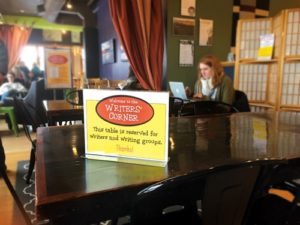
    Of course, if you want to be fancy, you could do both! Even if you have an afterschool group, you could also designate a corner of the library a permanent “Writers Corner” for anyone who wants to come at lunchtime or breaktime or free periods and just write on their own. You wouldn’t need a group leader or anything. Just a space they can use.

    When you think about it, libraries only exist because writers exist, but while there are many library desks for studying and computers for researching and sofas for reading, there are never areas specially intended for the people creating the books. It came as a revelation to me as a kid to realise that books were written by actual people. And it was only a small hop from realising those people existed, to thinking maybe I could be one of them. 

    And how special would it make you feel to have an area of the library just for you!

    So make your writers visible to the school and give them their own Writers Corners or Writers Desks or Writers Room or Writers Space or Writer in Residence and invite them to be a writer!


The Blank Page was created by Kelly McCaughrain, Children’s Writing Fellow for NI (2019-2021), as a support and resource for Librarians and Teachers running Creative Writing Groups in post-primary schools.

To read all the posts from the beginning, click here.

Recent Posts