The Blank Page

  • On (not) Making the Grade

    When I studied creative writing at Queens we were visited by my favourite writer, Marilynne Robinson, who also teaches at the Iowa University’s Writers Workshop. The IWW have produced 17 Pulitzer Prize winners and 6 recent US Poet Laureates, among many other honours.

    Robinson said she is asked by every university she visits, “What’s the IWW’s secret, why are you so successful?” And she always answers, “We don’t grade.” And, without exception, their faces fall.

    They hate that response. Because schools are under pressure to show results, especially in arts subjects, where there’s a sense that we must prove we’re ‘as good’ as STEM subjects by producing evidence of learning. Grades are a convenient way to do this. Even writing courses often include some academic writing to accompany your creative piece, as if to show you’re not just scribbling stories, you’ve done some ‘proper’ work too.

    The IWW students spend a year just writing and critiquing each other’s work. The staff encourage, support, advise, but they don’t ‘teach’, they don’t give assignments, and they don’t grade.

    17 Pulitzer Prizes. 6 Poet Laureates.

    I’m thinking they’re onto something.
    I recently reviewed Kate Clanchy’s inspiring book, ‘Some Kids I Taught and What They Taught Me’, about her teaching career in some of the more ‘difficult’ schools in England. She notes in the book that teaching is one of those professions that everyone feels qualified to tell you how to do. I’m not a teacher (or a librarian) and I’m very aware that I’ve set up a blog to give advice to teachers and librarians, so I was reassured to find that such an experienced and gifted teacher as Kate Clanchy is also ranting about the school curriculum.

    She points out that in other artistic fields we start by learning the skill, then we learn to analyse it. We begin by learning to play an instrument or draw a picture, then as we go through school, we learn to study our own technique and then to analyse music and art. But the English curriculum doesn’t usually include the practice of writing fiction and poetry, just of analysing it.
    “Only a couple of syllabuses allow for even the smallest amount of creative response – or any kind of creative writing – to be shoehorned in by dedicated teachers.”

    She suggests this is because everything that goes on in a classroom has to fall under specific learning objectives that can be built on. But how do you specify what has been learned by a student writing a poem? – Spelling? Rhyme? Empathy? Learning objectives don’t apply in the arts, where exposure to a piece of writing might teach you the difference between a noun and a verb, or it might alter your worldview forever.
    In her writing group she reads the kids a poem each week, then lets them write whatever they like. She says most of them don’t have the vocabulary to analyse the poem academically, and would lose interest if she made them do that. But they often respond to the poems and write their own versions.

    “The poem had been written, entirely in front of me, in less than an hour. Michael had chatted for at least 20 minutes of that; giggled to himself through most of the composition process; …. I could not have hoped for a more powerful or accomplished literary reply if I’d lectured my MA students for an hour and set the task as coursework. But no lecturing had happened at all. No one mentioned iambs, or stereotypes, or subversion or even gender. All we did, in our group of teenagers sitting round in the library – all I ever do, in fact – was read the poem, and chat, not about how the poem worked, but about what it provoked in us.”

    In our capitalist economy, all assessments really mean is – will this make money? Is my knowledge of physics good enough to earn me a salary?

    “The position firmly in place now in England… is that our schools should focus their attention on producing units of sellable labour power (school leavers).” – Michael Rosen

    That’s depressing enough if physics is your passion but at least it’s relevant, given that a high degree of accuracy will be part of your physics job.

    But does good/bad, right/wrong relate to writing? Yes, if you want to publish. But kids aren’t writing because they want to get published. Kids write to explore their inner landscape, experiment with language and ideas and vent their feelings. And what are we saying? Your feelings are a solid B but not good enough for an A? Your sonnet about your dying grandfather needs better iambic pentameter?

    I still vividly remember Anastasia Krupnik’s teacher giving her poem about sea creatures an ‘F’ because she hadn’t used capital letters or rhyme and the words were all over the page (like sea creatures). I remember it because the phrase ‘here in the whisperwarm wet’ has stayed with me for over 30 years, my 9 year old self thought it was such a beautiful poem.
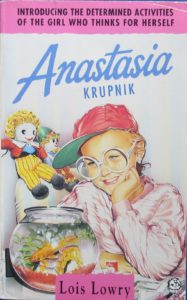
    Anastasia lifted her head and looked Mrs Westvessel in the eye. “I worked very, very hard on that poem,” she said, in a loud, clear voice.

    Mrs Westvessel looked terribly sad. “I can tell that you did, Anastasia,” she said. “But the trouble is that you didn’t listen to the instructions. I gave very, very careful instructions to the class about the kid of poems you were to write.”

    At home, that evening, Anastasia got her green notebook out of her desk drawer. Solemnly, under “these are the most important things that happened the year that I was ten,” in item three, she crossed out the word wonderful and replaced it with the word terrible.

    “I wrote a terrible poem,” she read sadly.

    I recommend Clanchy’s book and Rosen’s articles (and Anastasia Krupnik!) if you’re interested, but all I wanted to say here was, when you find yourself wondering how valuable writing Warrior Cats Fan Fiction really is to your young writers, or you suspect you should probably make them publish a booklet so everyone can see on Open Night how productive they are, just remember that you’re providing something that the whole rest of the curriculum doesn’t. You may be the last bastion of creative freedom in their education, and the results of your efforts may be intangible, ineffable, indefinable, but you have to have faith that you are making a difference.

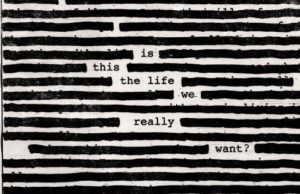


  • Blackout Poetry

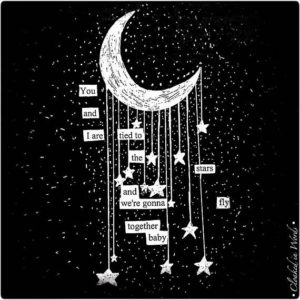
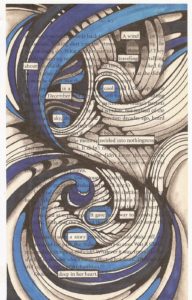
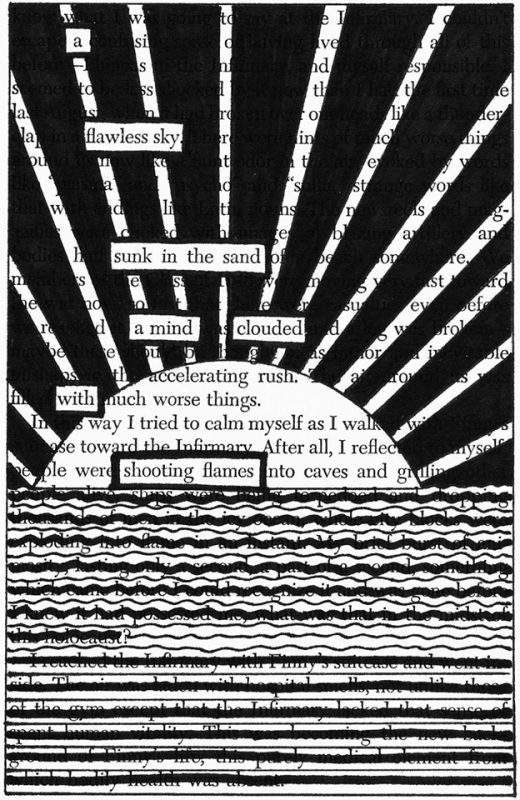
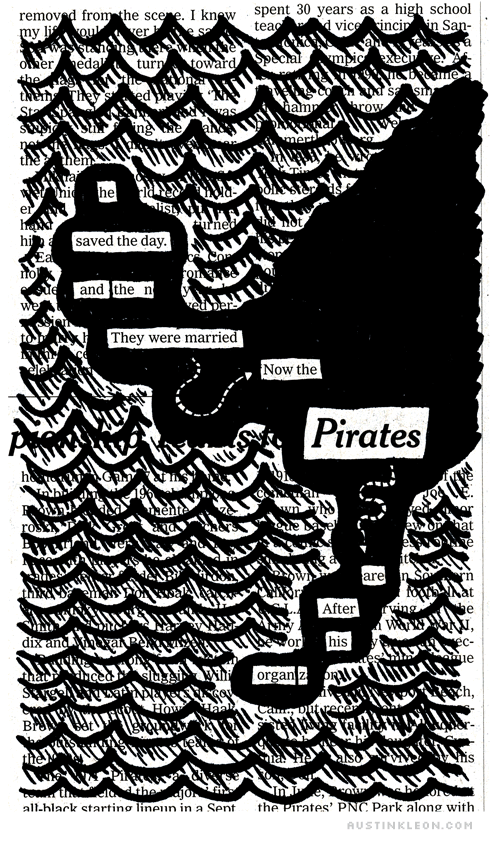
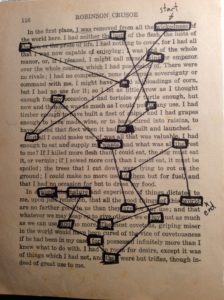
    Blackout Poetry is so simple and so much fun and you can end up with really beautiful results. It’s also great for helping nervous or blocked writers get going. In fact writers often use it as a way to kick start their creativity.

    It’s also known as Found Poetry or Erasure Poetry and the basic premise is that you start with a page of text, then you black-out the words you don’t want, leaving a poem on the page.

    Obviously you don’t want to be taking sharpies to the library books, so you can photocopy a few pages in advance for the kids to work on.


    Some tips:

    • To get the widest range of vocabulary, photocopy pages from a wide variety of books. Think fiction, magazine/newspapers, non-fiction, Classic novels, Sci-fi, Romance, Thriller etc. Absolutely anything can work.
    • Show them some examples, from very simple to very artistic ones.
    • If you can enlarge the pages, that can be good for turning them into pictures (see below).
    • Two or more people (or the whole group) can be using copies of the same page of text because they’ll all come up with completely different poems, which can be fun to compare.
    • They don’t have to read the page very closely in order to get started. In fact it can be better if they don’t, so they’re not influenced by the narrative on the page.
    • A good way to start is simply to skim-read the page and underline in pencil any interesting words or phrases, and then see if they can be linked together. The poem may become a narrative, or it may be about a clear idea, or it may be just a collection of beautiful images.
    • They can simply draw boxes around the words they want, or black out with marker the ones they don’t, or they can go the full Picasso and create works of art with felt tips or paint. (Thicker paper might be better if they want to use a lot of colour.)
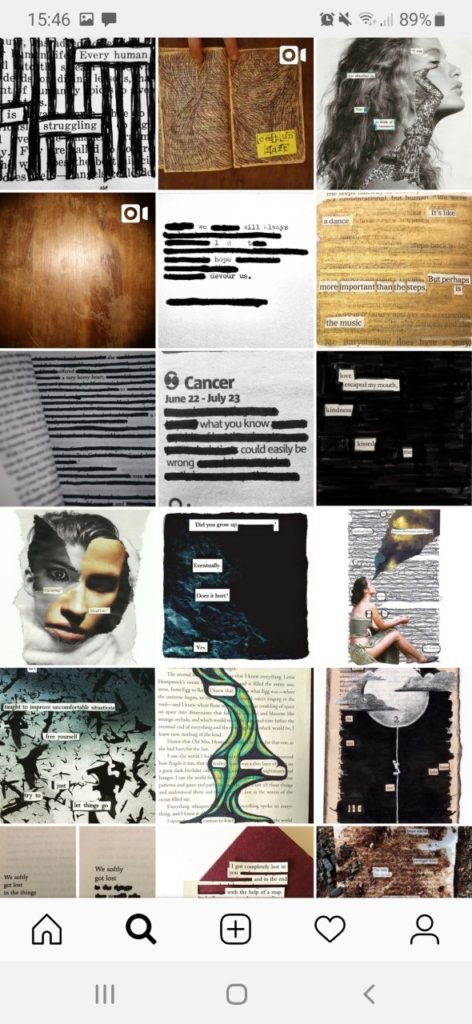
    • If any of your writers are on Instagram, there’s a whole hashtag for Blackout Poetry where you can see beautiful examples and post your own! #BlackoutPoetry

    Here are a couple of articles about Blackout Poetry, (though there’s really not much more to know about it) and some examples I found online.

    5 Tips for Creating Blackout Poetry

    What is Blackout Poetry?


    Some Instagram Blackout Poetry


    (As always, I would say that exercises like this can be fun, they can break the ice and they can be good for writers who need prompting, but if a writer has their own project on the go or their own idea about what they’d like to write, I’d always just let them get on with it and save the exercise for whenever they need it.)


  • Portable Poetry

    Today I have a poem for you, but before that I want to give you an update on how the Blank Page project is progressing.

    January has been a crazy month, but a good one. The response to the blog has been incredible. The fantastic people at the school library service helped to get the word out to all the schools during the first week of January and within about ten days all 25 of my resource packs were spoken for! There are brand new creative writing groups being set up all over the country as we speak and I can’t tell you how thrilled that makes me!

    The other piece of good news is that I might be able to rustle up some more packs! I managed to get some of the resources cheaper than expected, and then the ever-wonderful David at No Alibis bookshop gave me a hefty discount on the books just because he likes to support all literary endeavour especially encouraging young readers and writers, and my saint of a husband did all my website stuff (isn’t it good!), saving me hiring a tech-expert, so there is some funding left over. So if any more schools would like a pack for their writing club, do get in touch. And if you’re using the blog for tips and resources, remember to subscribe for notifications of new posts.

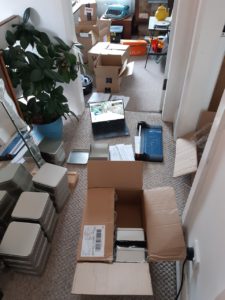
    I’ve spent a lot of January doing this – ordering stuff, putting stuff together, packing stuff – all while watching gardening videos on YouTube
    My whole house looks like this

    I think it’s just mindblowing that new clubs are being set up and might even continue to run for years and years, giving so many kids the opportunity to let their imaginations run wild after a hard day at school. I’m first in line to complain that there isn’t enough time for reading and writing for pleasure in our education system, but it’s so nice to see that we can make a difference ourselves even if our politicians are a bit rubbish.

    The project was all about NI schools but I’ve even been contacted by schools in England to say they’re using the blog too, which is a fantastic bonus and I hope it will continue to spread and be helpful to anyone who wants to encourage creativity in young people.

    Anyway, January has been spent in a deluge of packing materials and trying to figure out how courier systems work

    There was a LOT of packing materials

    but the boxes are finally out for delivery and I really hope they’ll inspire your writers.

    Waiting for the courier

    Speaking of inspiration in a box, in the meantime, you could show your writers this poem by Roger Robinson, who was just announced as this year’s TS Eliot Prize winner. The poem is available to read in this Guardian article and it’s called A Portable Paradise.


    A Portable Paradise by Roger Robinson

    And if I speak of Paradise,
    then I’m speaking of my grandmother
    who told me to carry it always
    on my person, concealed, so
    no one else would know but me.
    That way they can’t steal it, she’d say.
    And if life puts you under pressure,
    trace its ridges in your pocket,
    smell its piney scent on your handkerchief,
    hum its anthem under your breath.
    And if your stresses are sustained and daily,
    get yourself to an empty room – be it hotel,
    hostel or hovel – find a lamp
    and empty your paradise onto a desk:
    your white sands, green hills and fresh fish.
    Shine the lamp on it like the fresh hope
    of morning, and keep staring at it till you sleep.


    You could read it to your writers and, if any of them want to use it as a prompt for a story or poem, they could think about:

    • What would your paradise be?
    • How would you carry it around?
    • When might you need it and how might you use it?


    My paradise

    I’m off for a bit of a writing retreat paradise next week but I’ll be back the week after with more tips and resources! Thanks everyone who’s contacted me so far, and good luck with your writing groups. This is all so exciting!!!


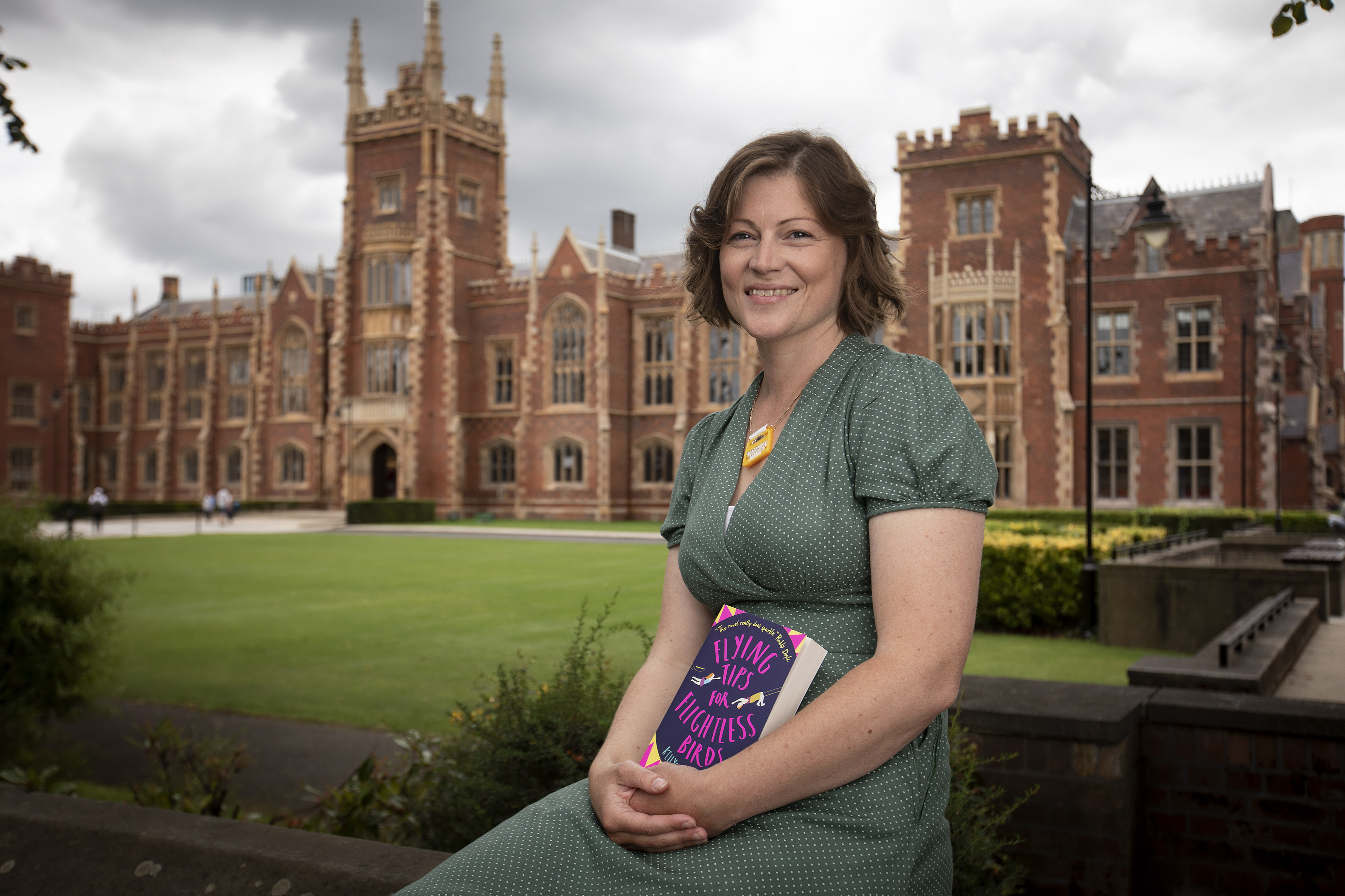
The Blank Page was created by Kelly McCaughrain, Children’s Writing Fellow for NI (2019-2021), as a support and resource for Librarians and Teachers running Creative Writing Groups in post-primary schools.

To read all the posts from the beginning, click here.

Recent Posts