The Blank Page

  • Lucky you stockpiled all those pens

    I’m kidding. No one writes with pens anymore, do they? Most of my young writers write on their phones! Can’t imagine how.

    Anyway, here’s some new creative writing opportunities to keep your thumbs fit:

    The Foyle Young Poets of the Year award is open for entries until 31st July. You have to be 11-17 to enter.

    They’re also keen to contact previous winners and highly commended poets to interview them for a research project so if you know any, send them to the website.


    Lidl Northern Ireland have launched #MyLidlStory – a 200 word story competition for 5-14 year olds. The story has to begin with the words ‘One day in Lidl…’

    This will be judged by Roddy Doyle, no less, and the winner in each age category wins a £250 Lidl voucher (think of the chocolate!) AND a creative writing masterclass hosted by Roddy Doyle and Fighting Words AND a signed copy of Roddy’s book. Entries have to be in by 31st May.


    Generation Lockdown is open for entries from 7-17 year olds until 17th July. They want to know about your life in lockdown, in the form of stories, personal experience or poems. This is for writers aged 7-17 and should be 700 words or less and will be judged by a group of published authors. Winners will be published in a book as well as winning a prize and you get to go to the book launch and meet the judges! All money raised from the book will go to the BookTrust charity.


    Our Corona Diary is creating an archive of young people’s experiences during lockdown by collecting their diaries. They also hope to publish some of them in an anthology so if you’d like to contribute, just start a diary. They stress that a diary doesn’t have to be written. It can be drawn, painted, photographed, filmed, recorded, sung, sculpted, knitted or a combination of all of these!

    They’re also collecting on Instagram (@ourcoronadiarygram) and Twitter (@OurCoronaDiary)


    So loads to be getting on with there. And if you know a young writer who’d like to share their work, I’m happy to do that here on The Blank Page, just send it to me. While I think it’s perfectly OK to write just for yourself and never show it to anyone or enter competitions, for some people it can be a real confidence boost to put their work out there so it’s great to have all these opportunities!


  • Essay Writing Competition: Discuss.

    I’m delighted to be involved in another exciting writing opportunity for secondary-age students in NI, and I’m particularly thrilled about this one because it’s for essay writing!

    Which you don’t see a lot of outside the classroom. I was always one of those odd kids who actually loved writing essays as much as I loved writing fiction. The general consensus about doing English Lit in school is that everyone loves books until you start making them write essays about them, and I completely agree, that can be off-putting, especially when it feels like the whole point of the essay is just to test what you know and it has to fit into a certain easy-to-mark structure that doesn’t allow any room for creativity.

    I’ve heard horror stories of students being given essay plans that tell them exactly how many paragraphs to write, how many sentences in each paragraph, and what each paragraph should do.
    But we’re not at school now! And Left Side Up’s Big Lockdown Essay Competition is all about my kind of essay writing. I’m very excited because I get to be a judge!
    I’ve always felt that essay writing can and should be a really creative process. There’s so much scope for self-expression and originality of thought. There are as many ways to structure an essay as there are ways to structure a novel. There’s the same scope for beautifully constructed sentences, fresh metaphors, startling similes, passion and personality.

    When I was a student we were literally told, Don’t use “I” in your essay and don’t give your own opinion because “who are you?” We were there to regurgitate stuff that had already been written, and that was all. This completely put me off studying English at Uni actually and I only went back to it ten years later.

    But things have changed, and the ‘personal essay’ is a really popular form of writing these days. This is usually autobiographical non-fiction, with an emotional and intimate style. Anyone can write it, you don’t have to be an academic, and you can play with the form and reinvent it to your heart’s content.

    And the best part is, you get to write about something you are passionate about. Not the exam text, not the set question, not someone else’s idea of an interesting subject. You can take a theme and use it to explore your own feelings, your own life. In my experience, you always produce better writing if you’re writing about something you care about. You’ll also enjoy writing it, and if you enjoy writing it, your reader will enjoy reading it.  

    The idea of an ‘essay’ might seem scary and difficult if it’s something you’ve only ever encountered in exams, but actually, if you’ve ever written a blog post, a diary, a letter, some journalism, then you’re already writing creative non-fiction. It’s much easier and more fun than you’d think.   

    The Left Side Up Essay Competition want “excellent, imaginative essays about our experience in lockdown here in NI.”

    There are three categories, themes and wordcounts:

    • Key Stage 3 the theme is ‘Home’ (750-1000 words)
    • For Key Stage 4 the theme is ‘Community’ (1000-1250 words)
    • For post-16s the theme is ‘Citizenship’ (1250-1500 words)

    These are huge themes, and that means there’s massive scope to interpret them in your own way. These words have as many meanings as there are people. So what does Home or Community or Citizenship mean to you? How has lockdown changed that? What will the post-lockdown future of these things be? Start brainstorming what these words mean to you and I bet you’ll come up with loads of ideas that you could write about. My advice is not to try and take on every single one of them because it’ll be overwhelming and you won’t be able to cover them fully within the wordcount. Pick a small, specific idea that means something to you or interests you and then explore all the aspects of it more fully.

    The judges have stressed that there is no marking criteria and no set structure. You don’t have to use quotes or references or a particular style. They just want you to be creative. You can come up with your own structure. It can be funny, sad, personal, about the future or the past. They don’t want stories, poems or plays but other than that, it’s up to you how you write your essay.

    They’ve also made a really helpful podcast about how to write a great essay, how to generate ideas, how to think about structure, and how to get started so I recommend you listen to that first. It’s on the website.

    Then when you’ve written your essay you can submit it via the website. The closing date is Sunday 24th May and winners will be published in a pamphlet entitled ‘Living in Lockdown’ as well as winning a prize. Highly commended essays will be published on the Left Side Up website.

    So teachers and parents please do recommend this to your students. It could be a really good home-schooling project as well as a chance to try a new style of creative writing that they mightn’t normally get a chance to within the curriculum.

    Good luck!
  • Two Minute Tales

    At Christmas I got to be a judge for BBC NI’s Two Minute Tales competition. Kids wrote Christmas themed stories that could be read aloud in 2 minutes and the winners were read on the radio and animated on the website.

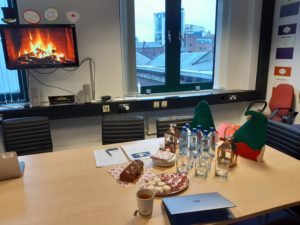
    It was so much fun to read the stories (there is some serious writing talent in NI). We did the final judging in the BBC offices and they’d dressed the room up for Christmas! (Note the awesome TV fire. Don’t know why I bothered tiling my fireplace TBH.)

    Being a writer is hard work, honest

    The response to the competition was so massive that they’ve decided to run it again! And, most excitingly, open it up to teenagers too!

    The competition was launched again on Monday and entries have to be in by Friday 15th May. The theme is ‘Home’, but you can interpret that any way you like. It can be magical, fantastical, realist, whatever you like. Even a spaceship, a castle or a fantasy forest is someone’s ‘home’. Or it could be set in your own home town (but obviously don’t write about real people, keep it fictional!)

    The stories must be no longer than 300 words and they don’t care if you can’t spell! The focus is on creativity rather than spelling and grammar. There are three age categories:

    • 5-8
    • 9-13
    • 14-16

    There’ll be a winner and two runners up in each category. All 9 stories will be recorded by an actor for a radio broadcast and the three winning stories will be turned into animations and featured across the BBC. Runners up will receive a specially commissioned illustration of a scene from their story. And all 9 stories will be published in a downloadable digital storybook.

    Entries will be judged on the following criteria:

    Originality – We want stories and characters we’ve never seen before!

    Plot – I firmly believe that plot comes from character. As readers all we want is a character we care about, and that character should have a goal (something they want to do/get/be etc). We read on to find out if they achieve it, and that’s all plot is.

    Characterisation – Emotions are what turn words on a page into real life people we believe in. What do your characters love/hate/fear/want?

    Language – You’ve only got 300 words so think carefully about every one of them. Is there a shorter way of saying something? Is there a more interesting or effective word you could use? Do we really need to know what they had for breakfast?

    Enjoyment – If you enjoy writing your story, your reader will enjoy reading it. Fun somehow gets woven into the stories you’ve loved writing and your reader will sense it. So the most important thing to do is have fun!

    You can enter via the website

    The website also has a brilliant ‘Creative Writing Kit’ to download with loads of tools and exercises you can use to develop your story, like story dice and character profiles.

    I’ll be judging the stories along with NI writer Lucy Caldwell, who’s one of my favourite short story writers and was shortlisted in the BBC National Short Story Award recently. If I was a young writer I’d kill to have her read my work!


    And if all this wasn’t enough, Fighting Words are also running their Global Writing Lockdown project! This is open to young writers all over the world (you can be over 18 for this one too). You can enter a story of up to 2000 characters, or you can send a poem, drawing, haiku, comic, anything you like! There’ll be a digital release party in July. Entries have to be in by 5th May so get going!

    Do pass these on to any young writers you know. Maybe make it a home-schooling project!

    Can’t wait to read your stories!


The Blank Page was created by Kelly McCaughrain, Children’s Writing Fellow for NI (2019-2021), as a support and resource for Librarians and Teachers running Creative Writing Groups in post-primary schools.

To read all the posts from the beginning, click here.

Recent Posts