The Blank Page

  • Let’s Pretend

    A lot of these posts will be on what we actually do at the writing group I’m involved with, this one is on why we do it.

    As I’ve said, I rarely do exercises with my teen writers, because I think they’re always much more engaged with their own ideas than anyone else’s, but I do suggest exercises they can do when they’re stuck for an idea of their own.

    Anyway, we were doing this exercise where you write twenty sentences, each beginning with the words ‘I remember’. Then you write twenty more beginning, ‘I wish’. Then you use what you’ve got as raw material to write a poem or story.

    One of the girls was reading out her ‘I remember’ list and said, I remember playing Pretend with my friend for the last time.

    I thought, Oh God, what happened, did her friend die or something? I hesitantly asked and she said, We were just playing Pretend one day and she suddenly stopped and said, “This isn’t working anymore,” and then we went inside and played video games.
    I think that probably broke my heart even more than the dead-friend scenario.

    My teen-writer said she remembered being devastated because she loved playing Pretend. This girl actually has one of the most incredible imaginations I’ve ever come across and I think she’d still be killing it at Pretend!
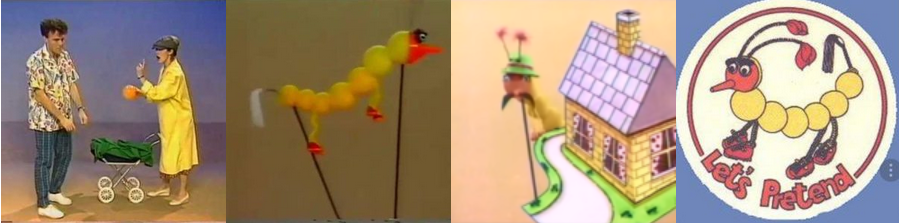
    Remember when this passed for TV entertainment? I loved this show!


    It felt like a moment from a coming of age novel. Is that really the defining feature of growing up? Losing your imagination?
    I’d like to think it’s not, or can at least be staved off a while, but I do notice there’s a definite difference between the way little kids and teenagers create. Little kids jump in with both feet and seem to swim in a sea of nonstop lunacy, while teenagers tend to spend the first few minutes looking around them, thinking, ‘What’s he doing? Am I doing this right?’ before embarking on something sensible/logical/rational/pedestrian and fussing over the punctuation.

    So maybe it’s not a failure of imagination, maybe it’s just that they have more filters. The ideas are in there but they get rejected because they’re too silly or too ambitious or too embarrassing. Too silly/ambitious/embarrassing for whom though? It seems like somewhere between childhood and adulthood we acquire an inner censor that sits in judgement. All writers have this. All people have this. It doesn’t help that (and maybe even stems from the fact that) the process of going through education is a process of being constantly judged and ranked. So I think a space for creativity that avoids judgements and restrictions is really valuable.

    Judgement should of course be part of education. If I ever have heart surgery I should hope my surgeon has been rigorously tested. And if I buy a novel, I sincerely hope the writer has put a lot of effort into learning her craft and been told in no uncertain terms by her editor to remove the crap bits. I’m not saying you can’t or shouldn’t teach the craft of writing, I just question the value of teaching it to kids, who I think have to explore creativity and discover a love of it long before they start worrying about quality.
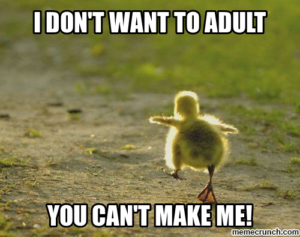
    And what they’re doing is not ‘mucking about’. Pure imagination is just as important as craft and it’s something that can be overlooked in writing classes precisely because writing teachers feel they have to teach you something specific and tangible. I have a friend who taught a workshop to university writing students and found they were completely shocked and stumped by an exercise that required them to just come up with ideas on their own out of nowhere. Because all they’d ever focused on in university was craft. It’s assumed imagination is a given if you’re a writer, but imagination can be hard. Especially if you got out of the habit of using yours when you were a kid.
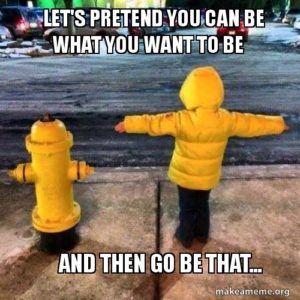
    I think when you give a child freedom to read and write whatever they like, two things happen:

    1. They learn craft (as well as SPG) through osmosis, through practice, in a completely unconscious and natural way.
    2. They develop imaginative muscles that will feed them with ideas through their adulthood.

    Conversely, I think when you focus on teaching craft and technique to a kid who isn’t that confident or interested, two things happen:

    1. They get bored or discouraged by the fact that they’re apparently getting it wrong or aren’t good enough.
    2. Their imaginations atrophy.


    Honing their craft will be important if and when they get to the point where they want to make a career of writing. But imagination is important for everyone, whether they ever want to be professional writers or not. The process of creating confers benefits that have nothing to do with the end product. Imagination is a refuge, a problem solver and the source of every new thing that’s ever come along.

    So that’s why I think it’s important that young people have the chance to nurture theirs, and I love that our writing group gives them the opportunity to play Pretend a while longer.
     

  • The Little Box of Inspiration

    In my primary school we’d occasionally be given the opportunity to write stories. But what I remember about these exercises is that, like most things in life, they came with a catch. The teacher would give you the first line of the story, or the title, and you had to finish it.

    To me that always felt like being promised something exciting and then having it snatched away. I remember one that had to be called ‘The Magic Shoes’. I didn’t want to write about magic shoes, I wanted to write about meeting Santa. But I was an obedient kid so I wrote a story about meeting Santa, in the last sentence of which, Santa declared I had been so helpful that he’d give me the gift of a pair of magic shoes.

    Alas, my teacher read this work of literary genius and said only, ‘You haven’t talked about the shoes enough.’ I kinda knew that wasn’t the point, but at 8 years old, I hadn’t the vocabulary to tell her to stop crippling my creative spirit, man.

    Instead I just went home feeling like my story wasn’t very good.

    We all agree that kids are much more creative than adults (if you don’t believe this, go get a cardboard box and try playing with it) so why don’t we trust them to come up with their own writing exercises as well as their own stories? If you want a kid to exercise their muscles you don’t carry them to the park and do the running around for them. 

    Standing there in front of a group of expectant kids, perhaps we rely on activities because we’re afraid of there being a gap. A silence. A space where they’re doing nothing, wasting time, thinking about the weekend, not paying attention. In secondary school especially, where every minute counts, time-wasting is sacrilege.

    But here’s the thing. Creativity happens in the gap. It happens in the background. In the daydreaming, dandering, doodling, absent-minded spaces between things. (‘Wasting’ time is a seriously underrated activity.) And all those ‘Write a story using these ten verbs!’ exercises can be a distraction from a child’s own ideas. We want to give them assistance but actually what we may be doing is giving them restrictions.

    Recently in my writing group, I asked one of the girls what she was planning to write today and she said she’d been reading a story and liked it so much she wanted to write her own ending before she read the real one.

    Fantastic, I said! Brilliant idea! It’s exactly the same writing exercise I was given in primary school but the difference is she came up with it herself because she’d found something that sparked her imagination. If I’d suggested this exercise to her with a story opening that I’d chosen, she’d have been like,

    So Rule Number One at our club is always ‘write whatever you like’. But having said that, there is also a place for writing exercises and prompts. I am not at all against writing prompts, they can produce amazing things. My whole novel came from a prompt in fact.

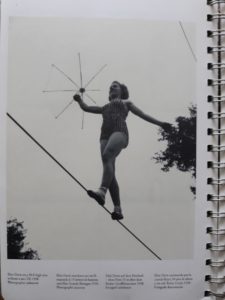
    This one

    Something about this picture in my Redstone Diary grabbed me and I wrote a tiny story on the back of a postcard about a high-wire walker. She later became Alouette Franconi, matriarch of the Flying Franconis circus family in Flying Tips and she pretty much changed my life. Writing prompts can be brilliant.

    They’re also practical. Because there are times when a young writer is just too tired to think. And there are kids with an inner critic so loud they have no faith yet in their own ideas. So prompts can be helpful and I do make them available, but I make it clear that they’re optional and don’t have to be taken literally, they’re just jumping off points. I’ve noticed that the more their confidence develops, the less they use the prompts, but it’s helpful to have some available, so I’ve put together some for you.

    I mostly found these by trawling the internet. There are many places to get prompts online but there’s probably one good exercise for every fifty rubbish ones, so it’s time consuming. I’ve collated 36 good ones I’ve found, but there are also links to places you can get more if you want. (See below)

    At our group, I put each prompt in a tiny envelope in a biscuit tin. Et voila: The Little Box of Inspiration.

    Remember this show?!

    I leave it on the table and if a writer wants a prompt they can grab one. They don’t have to use the prompt if they don’t like it, but they should take five minutes to think about it before giving up, because sometimes they’re surprised with what they come up with. They also write their names on the envelopes they’ve opened, so they know they’ve had that one.

    For a group activity, you can also provide empty envelopes and slips of paper and get them to write their own prompts to add to the box. This gets them thinking about things they’d like to write about and the kind of prompts that work for them, it gives them a sense of ownership of the group, and they love hearing what another writer comes up with when they use their prompt.

    I hope this is a useful backup but I honestly think you’ll find lots of kids prefer to come up with their own ideas and if that’s the case, sit back and let them.

    And if your group is happy to share, do send me some of their work! I’d love to read it and feature it on the blog, with their permission.

    Kelly

    x


    Link to Download: The Blank Page Little Box of Inspiration


    Links to prompt websites:

    https://writeshop.com/creative-writing-prompts-teens/ – this is a massive site with writing exercises for kids of all ages.

    https://www.teachingenglish.org.uk/article/teens-writing-skills

    https://www.cambridge.org/elt/blog/2017/09/26/get-teens-writing-creatively-1-top-tips/ – this one includes stories written by teens that might inspire your writers.

    https://www.journalbuddies.com/journal_prompts__journal_topics/creative-writing-prompts-for-tweens/ – 55 prompts for tweens and teens

    https://www.journalbuddies.com/creative-writing-2/teen-prompts/ – 31 prompts for teens


    (more…)

  • Top Tips

    As I said in the last post, the format at my writing group is REALLY simple. I don’t do any formal teaching or give instructions or exercises, we just let the kids write whatever they like and they respond well to that, producing fantastic writing that’s really personal and important to them.

    But there are ways you can inspire, help and teach them without putting them under pressure or making them feel like they’re doing homework and I’ll be sharing those as we go along.

    First up: Top Tips

    Something that always inspires me to write, is reading interviews with other writers. Mostly this is to reassure myself that they ALL find it difficult, but the best bit is when they give you their ‘Top Ten Tips’ for writing. Every writer gets asked for these apparently, there are dozens of them online.

    When I first began working with my young writers, I started choosing an author each week and printing out their Top Ten Tips to give to the kids. Sometimes they’d heard of the writer, sometimes they hadn’t, it didn’t matter. They always looked forward to the tips because they’re quick, useful, often funny, and they come from REAL writers, which, I’m sorry, is always going to be more impressive than REAL librarians and REAL teachers (totes unfair, I know).

    But the big benefit of these is seeing that every writer does it differently. It’s great when you read a tip and think, ‘Oh! I do that too!’ because you feel like you must be getting it right, but it’s also great to see the massive variation in writing methods because it drives home the point that actually, you can’t possibly be getting it wrong.

    Sometimes these tips generate some discussion, sometimes not, that’s OK. I think if you demand a discussion then you kinda turn it into ‘an activity’, like they’re being tested on their response. But often they’ll respond naturally to something that catches their eye and you can use that to talk to them about it. Or you can say which ‘Tip’ you found interesting and they might respond to that.

    Sometimes advice will speak to them immediately, sometimes it’ll sink in slowly, sometimes it’ll sit in the back of their mind for years before it clicks, sometimes it’ll consciously or unconsciously change they way they write, sometimes they’re not be the least bit interested in how anyone else does it because they write for themselves alone, and in a way that’s the purest form of creativity.

    It’s just a potential discussion starter that might get them thinking about their technique but I wouldn’t labour it. Just give them the tips as a point of interest and then let them get on with writing whatever they like.

    These Top Ten Tips are all available online if you Google ‘writing tips’, but you’re very busy so I’ve compiled them for you into one big document so if you’d like to use them, you can just choose a writer each week and print off their tips for your young writers. There are 34 writers here, that’s roughly one for every week of the school year!

    And they range from the inspirational:

    “Be without fear.” AL Kennedy

    to the minutely technical:

    “Never use the word “then” as a ­conjunction – we have “and” for this purpose.” Jonathan Franzen

    from the cynical:

    “The first 12 years are the worst.” Anne Enright

    to the aspirational:

    “The prerequisite for me is to keep my well of ideas full. This means living as full and varied a life as possible, to have my antennae out all the time.” Michael Morpurgo

    and the practical:

    “Do back exercises. Pain is distracting.” Margaret Atwood

    to the hilarious:

    “If you have to read, to cheer yourself up read biographies of writers who went insane.” Colm Toibin.

    There’s something for everyone. Other places to get writing advice include YouTube which has loads of short (and longer) interviews with writers. You’ll only get away with longer ones if they’re funny but I recommend these ones:

    https://www.youtube.com/watch?v=xPN7vDu9Rsk Neil Gaiman being very funny on where he gets his ideas, daydreaming and what happens if a werewolf bites a goldfish (12mins)

    https://www.youtube.com/watch?v=lwhOd65gGoY Stephen King on his writing process (7mins) “Plot is the last resort of bad writers”

    https://www.youtube.com/watch?v=R_HXvxgCkxw JK Rowling’s 5 Top Tips (4mins)

    And if you run out of mega famous writers, here are mine!

    Kelly McCaughrain’s Top Ten Writing Tips

    1. Your favourite book by your favourite author started out as a rubbish first draft. Aren’t you glad they didn’t give up on it?
    2. People only think their work is bad when they’re talented enough to spot the bad bits.
    3. Keep a diary. It’s the most important and original story you will ever write.
    4. Write a better world than the one you live in. This is how better worlds come to be.
    5. Be kind to your fellow writers. These people are your tribe.
    6. Experiment. What’s the worst that could happen?
    7. The characters we love most are always the outcasts.
    8. Write the story you’d most like to read.
    9. There’s no such thing as weird. Every character makes sense if you can see inside their heads.
    10. Be brave, not perfect.

    And here’s the link to download the PDF:  The Blank Page Top Tips

    I hope these are useful to you!

    Kelly

    x

The Blank Page was created by Kelly McCaughrain, Children’s Writing Fellow for NI (2019-2021), as a support and resource for Librarians and Teachers running Creative Writing Groups in post-primary schools.

To read all the posts from the beginning, click here.

Recent Posts