The Blank Page

  • We Don’t Need No Education

    It is a truth universally acknowleged that kids hate school. Even the ones who love it, are publically obliged to swear it’s hell on toast. Which makes me wonder why writing groups for kids are based on a traditional classroom model: An adult sits at the front, talks at you a bit, sets an exercise and then judges your work.
    Not saying there’s anything wrong with classrooms or teachers, just that, for some kids, the classroom setting is tied up with notions about assessment and right/wrong, pass/fail, which isn’t really what creativity is about.

    Most writing classes have to be run this way because it’s usually a one-off session or a course that people have paid to do, so of course you need to provide actual instruction. And this can be brilliant and helpful. But a regular school writing group has certain advantages that you don’t get from one-off taught classes and we can exploit these. Such as:

    • It’s a free and they don’t have to commit to regular attendance, which can be off-putting when you’re a GCSE-facing 16 year old with a boyfriend, piano lessons, weekend hockey and a babysitting empire.
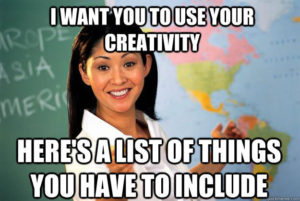
    • It’s self-directed. Some people just don’t respond well to prompts and exercises. As soon as you give me a topic to write about, it’s the last topic in the world I want to write about.
    • It’s regular. I’ve done writing workshops where, understandably, no one is willing to read aloud their first draft efforts to complete strangers. But because my young writers have become friends, they’re quite comfortable with it.
    • It’s social. They need time after school to decompress and exhale all the conversation they’ve been suppressing since 9am, and sometimes there’s intermittent talk all the way through, but actually, it’s surprising how much work they do. In a way, it emulates a real writing life – there’s a lot of Facebooking, procrastinating and biscuits, but the work somehow gets done anyway.
    • It’s not like school. One of my young writers told me that their school librarian set up a lunchtime writing club but they didn’t like it. When I asked why, they said, ‘She makes you do stuff.’ Much as I would have loved a writing group at my school, I can understand why kids wouldn’t want to spend their only break in a long school day at something that felt like another class. But there are ways to avoid that dynamic.

    The most important (and easiest) thing a regular writing group provides is Time and Space. Some of my young writers tell me that when they’re at home they never write because there are too many distractions. A writing group is time and space devoted purely to writing, and any writer will tell you that is invaluable. I really believe you don’t have to do much more than provide that time and space.

    In our product-driven, value-for-money oriented culture I feel a bit weird asking you to follow my blog or let me come to your school so I can tell you how to do nothing but honestly it works. And it’s harder than you think to get your head around that. Especially if you’re used to the Education Boards breathing down your neck to prove exactly which learning outcomes boxes you’ve ticked today.

    (And just because you’re not doing formal, traditional teaching doesn’t mean that you’re not teaching them anything or that they’re not learning anything, but we’ll go into that more later.)

    The kids are used to seeing that classroom/teacher setting as ‘work’ (I know that’s terribly unfair to all those amazing teachers who put so much effort into engaging their students and making school fun, but at the end of the day classrooms are assessment-based and that can be off-putting for some kids).

    Personally, I think libraries are great places to create a more relaxed atmosphere. And librarians would be great at this (Yay Libraries!). I’ve been meeting with librarians to tell them about the project and what I’ve learned from being behind the scenes at a librarian’s meeting is how much they care, how much they want to contribute to their schools, and how they know and interact with the students in a different way to the way teachers know and interact with them.

    Obviously, teachers can also be brilliant creative writing mentors and I hope they’ll be inspired to do so (and I know some who already are), they just might have to negotiate that dynamic more carefully to avoid those assessment-y classroom-y assumptions a lot of kids will have about teachers – They make you do stuff…

    Also, I’m aware that some schools don’t have a library or librarian at all (grrr).

    So you must do what works for your school.

    With my young writers, the basic format is that we meet after school for two hours (you may have less time but that’s fine). We spend the first twenty minutes chatting and catching up and then the kids spread themselves around the space and write whatever they want for an hour, then we spend the last half hour reading our work aloud (if they want to) and giving each other feedback. It’s really that simple.

    Having said all that, it can help to provide some direction for those kids who want it, making sure they know it’s all optional, and there are ways you can help them develop as writers and as people without making it feel like school, and I’ll be going into much more detail about how we do that and providing resources you can use, but I can’t stress enough that all you really need to provide is that time and space, encouragement and freedom. The kids will do the rest.

    The main point I want to get across here is that it’s not hard at all and anyone can set up a group like this. I hope you’ll consider it and I hope I can support you along the way!

    Kelly

    x

    (You can ‘Subscribe to the Blog by Email’ at the bottom of the page)

     

  • Minifesto

    Welcome to The Blank Page Blog! Novels are all very well but I do love a good blog. They’re useful, bite-sized and create communities of likeminded people. Plus you get to use memes, and who doesn’t love a meme?

    So I have set up The Blank Page for all things Fellowship, and I thought I would start with a post on being appointed as Seamus Heaney Children’s Writing Fellow for Northern Ireland and my plans for this year, because that’s probably the best way to introduce myself.

    What is a Children’s Writing Fellowship, I hear you cry. Well, funnily enough, I asked Damian Smyth from the Arts Council the same question. And the answer was, ‘whatever you make it’. It’s essentially two years of time and space for me to write and work on projects that I’m passionate about.

    So you can think of this first blog post as a statement of the things I’m passionate about and would like to contribute to through this wonderful opportunity, and my plans for working with schools this year.

    A mini-festo, if you will!

    Children’s literature

    Firstly, to say I feel honoured about the post would be an understatement. And I think any role that promotes children’s literature is fantastic news. Michael Morpurgo and Ted Hughes set up the first UK Children’s Laureateship because they felt it was unfair that children’s literature receives less recognition than adult literature. I completely agree.

    Childhood reading is such a formative thing. We know that children who read become more empathetic adults with greater ability to express themselves, more emotional resilience and a host of other benefits, yet children’s books get less media coverage, fewer reviews, less shelf space, less money and less respect. (I find it hugely ironic that childhood reading predicts higher earning-power as an adult – unless you want to be a writer. Especially a children’s writer.)

    It annoys me greatly when people dismiss children’s literature as being trivial or less important than adult literature. It’s more important because we encounter it at a time in our lives when we’re at our most impressionable. It shapes individuals, and individuals shape society. I’m thrilled to see this being recognised in Northern Ireland and I applaud the Seamus Heaney Centre and the Arts Council Northern Ireland for creating this fellowship.


    Childhood Reading

    It’s incredible the wealth of experience you can pour into a child’s head through stories. In a year of reading they can live hundreds of different lives in hundreds of different places and experience hundreds of different relationships and they’re essentially learning how to be human in hundreds of different ways.

    That’s absolutely priceless and it would take you the rest of your life to gain a fraction of that knowledge, experience and emotional intelligence. I have no doubt that books not only taught me what I know, but made me who I am. I wish kids were given more dedicated reading time in schools, free of assessment of any kind. Just give them some books! Give them some time! Give them a library!


    Creativity

    Opportunities to be creative are especially valuable as children grow older and their school environment becomes increasingly exam-focused. Writing was the only thing I was particularly good at in school, and it would have meant the world to me to see creativity as something that was valued as much as exam results.

    I think it’s a little crazy that there’s only room in the curriculum for things that can be marked and measured, with the result that creativity either gets squeezed into a narrow, measurable format or it’s left out of the curriculum altogether. I’m not a teacher but I’ve had many conversations with teachers and parents who feel the same. This seems to be a trend in education that’s only getting worse, and we’re seeing a decline in the uptake of Arts subjects in secondary education as a result .

    I don’t think creativity should be graded or corrected or used as a vehicle to teach spelling. Creativity is a personal thing. It comes from who you are, not what you know. Grading that work essentially tells kids that who they are can be ‘wrong’ or ‘bad’, or not as good as the person sitting next to them. That’s not only unhelpful, I think it’s harmful.

    Short of marching on Westminster and chucking novels at politicians, I can’t do much about the curriculum, but I do think it’s important that teenagers get the chance to be creative in school and I’d like to focus this fellowship on contributing to that.

    Well, since you ask… During author visits in schools I always ask the kids if they like to write and there are always some who say yes. But when I ask if they have a writing group or any outlet for their writing, it’s often no.

    I want to use my time as Children’s Writing Fellow to promote giving kids time and space to be creative in school. Specifically, I’d love to encourage and help secondary schools to set up or run creative writing clubs for their students and that’s what The Blank Page blog is for.

    I work with teenage writers as a writing mentor with Fighting Words Belfast, running their Write Club group. The group has gone from strength to strength and I believe it’s because we have a format that the kids really respond well to and I’d love to spread that format around.

    I completely understand why anyone might be a little daunted by the idea of starting a writing club. When I took on Write Club I felt incredibly nervous. How could I come up with enough writing exercises and writing advice and lesson plans and writerly wisdom to sustain this week after week? It sounded exhausting. And I’m a writer! If you’re not a writer yourself, it might be even more daunting. And repeating the same exercises year after year can get boring and sometimes groups just dwindle away for lack of enthusiasm.

    But what my young writers have taught me is that it’s really not hard at all, and actually sometimes the less you do the better. In fact, what seems to work for them, and what they don’t get enough of in academic settings, is freedom.

    Freedom to write the wrong words. Freedom to write the weird words. Freedom to write their own words. Essentially, what I do with my teen writers is let them be completely self-directed. They write whatever they want, it’s completely up to them. No writing exercises, no lesson plans, no prepared readings, no analytical responses, no dramatic readings in assembly. Easy right? I know you’re waiting for the catch but there isn’t one. This is actually a huge advantage of working with teens that you don’t get with younger kids, who may need much more input from you.

    The focus is on giving teens time and space to write without any academic pressure or formal teaching. I’ve heard a lot of teachers say that they’re concerned because kids get less and less time to do anything creative, so I think writing groups could be really important for them.

    Of course, I also have some tricks up my sleeve for the days when a young writer just isn’t in the mood or wants a gentle push. But these aren’t complicated things and I’ll be sharing them with you through this blog.

    I think the hardest part of all this is convincing ourselves, as adults, to sit back and not interfere. To stop feeling like we haven’t done our jobs properly if we haven’t produced an end product in the form of a published pamphlet or a One-Act Play or at the very least some tickable Learning Objectives. I’ll be talking about all that too.

    I’ll be talking more about how writing groups work and why, plus posting helpful resources and links, and my hope is that some librarians and teachers out there might be interested in setting up a group in their school library (if they actually have a library – don’t get me started) and that the blog might be a support for them. Existing groups might find it useful too. I’m also happy to chat via email or comments if you have specific questions or problems, and I’d love to post examples of your students’ work if they’d like to share it.

    I’m also offering to come out and visit some writing groups (existing or new) in NI to meet the kids and encourage them with their writing. This would be after Christmas so if you’re up and running by then and would like a visit do let me know (these visits will be free, thanks to the Arts Council NI and Seamus Heaney Centre Fellowship, and I will bring along some fun resources for your group, also funded by the Arts Council NI!)

    But I want to stress that visits and resources aren’t necessary requirements and that any school can read The Blank Page Blog and use it to set up a group of their own. The blog is a place for me to geek out about my favourite thing – encouraging young creatives – as well as giving group leaders some tips, resources and general support with working with your own creative young people. And the blog will continue to exist after my time as Children’s Writing Fellow has ended so if this year isn’t good for you, maybe you can use it later on.

    In the next few posts I’ll get down to the nitty gritty of running the group but for now just let me say that running a writing club has been one of the most rewarding things I’ve ever done. I honestly feel privileged to be entrusted with their stories and it’s heart-warming to see how supportive they are of each other and what a confidence boost it gives them. To know that the group’s feedback and encouragement may have sent them home with a warm glow after a day that maybe wasn’t so full of warm glows is truly wonderful.

    So that’s me! Thank you for taking the time to read this (future posts will be shorter, I promise!) Please do spread the word to any librarians, teachers or parents you think might be interested in encouraging creativity in their young people. You can click the Subscribe button on the sidebar (on the right) to get an email alert when new posts go up, or follow me on Twitter.

    I really hope you’ll consider reading on and maybe setting up a group in your school!

    Kelly

    x


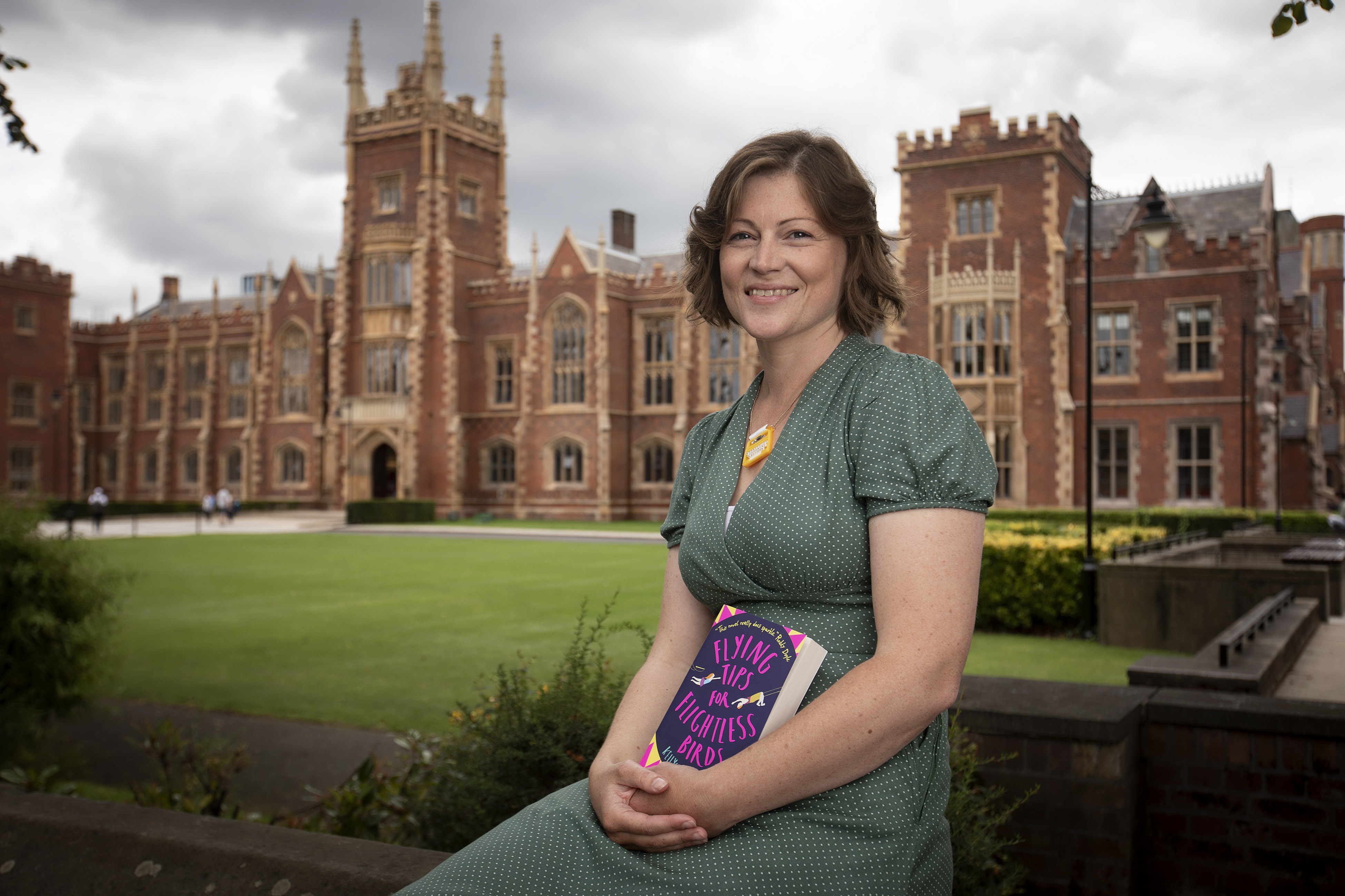
The Blank Page was created by Kelly McCaughrain, Children’s Writing Fellow for NI (2019-2021), as a support and resource for Librarians and Teachers running Creative Writing Groups in post-primary schools.

To read all the posts from the beginning, click here.

Recent Posts